
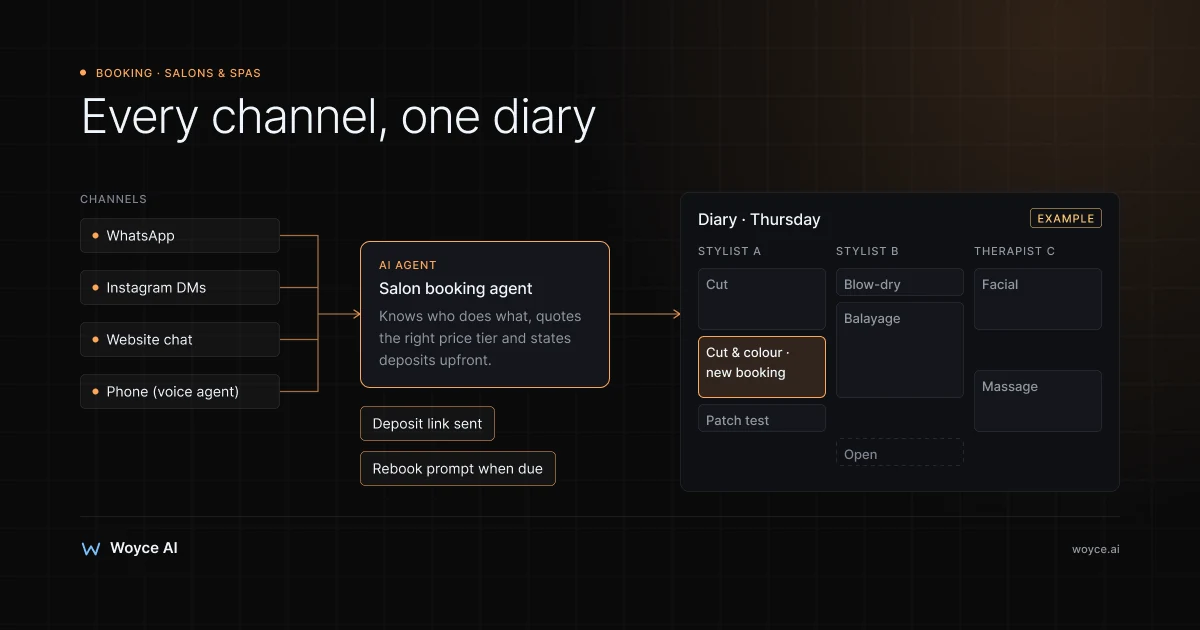
A salon's front desk is usually a stylist with wet hands. Booking requests arrive by Instagram DM at 11pm, by WhatsApp during a colour appointment, and by phone while the only person who could answer is halfway through a blow-dry. Some of those requests get answered the next morning. Some never do, and the client books with the salon down the road that replied first.
An AI agent for salons and spas takes over that communication layer. It answers booking requests on WhatsApp, Instagram, your website and, if you want, the phone line. It checks real availability for the specific stylist or therapist the client wants, takes a deposit where your policy requires one, sends reminders, and nudges clients to rebook when their cut, colour or facial is due. Your team handles the clients in the chair and the conversations that genuinely need a person.
This guide covers what a salon AI agent does day to day, how it handles stylist-specific availability and deposits, how it works with booking systems like Fresha, Square Appointments and Vagaro, what a realistic rollout looks like, the mistakes that cause trouble, and when you're better off with the booking software you already have.
The Booking Problem Salons Actually Have
Most salons don't lack demand. They lack someone free to answer it.
Look at where booking requests come from in a typical week. Regulars message their stylist's personal Instagram. New clients find you on Google Maps and tap "message" or "call". Someone's friend sends a WhatsApp asking whether you do balayage and how much it is. A few people use the online booking link, and a few of those abandon it because they couldn't work out which service to pick.
Every one of those channels needs an answer, and most of the answers are the same few things: what's available, what does it cost, how long does it take, who can do it, and is there a deposit. None of that needs a senior stylist's judgement. All of it currently takes a senior stylist's time.
The second problem is quieter. Clients who don't rebook at the end of their appointment drift. A client who would come back every six weeks for a cut comes back after ten, or not at all, because nobody reminded them and booking felt like a chore. That lost frequency rarely shows up anywhere as a number, but it's often the biggest revenue leak in a salon.
What a Salon AI Agent Does
An AI agent is different from an online booking widget. A widget waits for the client to come to it and fill in a form. An agent answers in the conversation the client already started, in plain language, and does the booking there. (If you want the general mechanics, our guide to AI agents for appointment booking covers them in detail; this post focuses on what's specific to salons and spas.)
Booking across WhatsApp, Instagram, web and phone
The agent sits behind the channels clients already use:
- WhatsApp Business, through the WhatsApp Business Platform (the API version, not the phone app). This is usually the busiest channel for salons in markets where WhatsApp is the default messaging app. Our WhatsApp AI chatbot guide covers the setup and the messaging rules.
- Instagram DMs, through Meta's messaging API for business accounts. A lot of salon discovery happens on Instagram, and clients expect to book from the same thread where they saw your work.
- Website chat, for clients browsing your services and price list.
- Phone, through a voice AI agent that answers calls when nobody at the desk can, books the appointment in the same call, and texts a confirmation.
A client writes "can I get a cut and colour with Priya next Thursday after 5?" The agent works out the services, checks Priya's diary for a slot long enough for both, offers the options that fit, and books the one the client picks. If Priya is fully booked, it offers her next free evening or another colourist with the same skill level, depending on the rules you set.
Stylist-specific availability and service rules
Salon scheduling is harder than most appointment scheduling, and this is where generic tools break down. A good salon agent needs to know:
- Who can do what. Not every stylist does colour corrections, extensions or keratin treatments. Not every therapist does hot stone massage. The agent only offers a service with staff who are qualified for it.
- How long each service takes, per person. A senior colourist might do a full head of highlights faster than a junior. If your booking system stores durations per staff member, the agent uses them.
- Processing and gap time. Colour development time can often be used for another client's quick service. If your system models that, the agent respects it; if it doesn't, the agent books conservatively.
- Rooms and equipment. Spas run out of rooms before they run out of therapists. A couples massage needs a double room and two therapists free at the same time.
- Price tiers. Many salons price by stylist level (junior, senior, director). The agent quotes the right price for the person being booked.
- New client rules. Some services require a consultation or a patch test first. Many colour services carry a patch test requirement 48 hours before the appointment, depending on the products used. The agent can ask whether the client has had one recently and book a patch test first if not.
These rules usually live in the head of whoever has run the desk longest. Writing them down is the most valuable hour of the whole project, and the agent can only be as good as that document.
Deposits and no-show policy
Deposits are the most direct tool salons have against no-shows, and they're also the step clients are most likely to push back on over the phone. An agent handles them consistently:
- It explains the policy in plain words before the booking is confirmed ("a £20 deposit secures the slot and comes off your bill; cancellations with less than 24 hours' notice lose the deposit").
- It sends a payment link through your booking platform's own payments or through Stripe, Square or Razorpay, depending on your setup and market.
- It holds the slot for a short window and releases it if the deposit isn't paid.
- It applies the policy the same way every time, including to the regulars your team finds it awkward to ask.
Whether to charge deposits for everyone, only new clients, or only long services is a business decision. Many salons start with new clients and services over a certain length, because those are where a no-show costs the most. The agent just enforces whatever you decide.
Reminders and confirmations
The agent sends a confirmation straight after booking and a reminder before the appointment, usually 24 or 48 hours ahead. On WhatsApp, reminders outside an open conversation have to use message templates that Meta has approved, so these are written and submitted during setup.
The reminder lets the client confirm, cancel or move the appointment in the same thread. That matters more than the reminder itself. A client who can reschedule with one reply usually does; a client who has to phone during opening hours often just doesn't turn up. When a slot opens, the agent can offer it to clients on a waitlist for that stylist or service.
Rebooking cycles
This is where a salon agent earns its keep over months rather than days. Most salon services have a natural return interval:
| Service | Typical return interval (illustrative) |
|---|---|
| Men's cut | 3–5 weeks |
| Women's cut | 6–10 weeks |
| Root colour | 4–8 weeks |
| Gel or acrylic nails | 2–4 weeks |
| Lash extensions infill | 2–3 weeks |
| Facial | 4–6 weeks |
The agent can message a client when they're due ("It's been six weeks since your cut with Sam. She has Tuesday at 4 or Thursday at 6 next week. Want either?"). The message is specific: a named stylist, real slots, one-tap reply. That's very different from a generic "we miss you" marketing blast, and clients treat it differently.
You decide the intervals per service, whether the message goes out automatically or only for clients who didn't rebook at checkout, and how often the agent is allowed to follow up. Clients who reply "not now" or "stop" are left alone, and marketing opt-in rules in your market (GDPR and PECR in the UK, TCPA rules on SMS in the US, WhatsApp's own opt-in requirements) apply to these messages just as they would to any other.
Answering the questions in between
A large share of salon messages aren't bookings at all. They're "how much is a full head of highlights for long hair?", "do you do men's colour?", "is there parking?", "what's the difference between a classic and a hybrid lash set?", "can I bring my daughter?" The agent answers from your price list and FAQ, with the caveats your team would add ("long or thick hair may be priced higher at consultation").
It should not guess. If a question falls outside what it's been given, such as a skin reaction after a treatment or a complaint about a previous visit, it hands the conversation to a person with the full thread attached.
A Week With an Agent Running (Illustrative Example)
To make this concrete, take an illustrative 4-chair salon with two treatment rooms, taking roughly 300 bookings a month across WhatsApp, Instagram, the phone and an online booking link. This isn't a client of ours; it's a worked example to show where time goes.
Before the agent, the owner and senior stylist spend their breaks and evenings clearing DMs. Phone calls during appointments go to voicemail, and some callers don't leave one. Deposits are taken inconsistently because asking for one over the phone feels awkward. Rebooking happens at checkout when someone remembers to ask.
With an agent running:
- Late-night Instagram and WhatsApp requests are booked or answered within a minute, against the live diary.
- Calls that would have gone to voicemail are answered, and routine bookings are completed on the call.
- Every new client booking for a colour service gets the deposit link and the patch test question automatically.
- Clients get a reminder two days ahead and can move their appointment in the same thread, which frees the slot for the waitlist.
- Clients who left without rebooking get a message when their service interval is up.
- The team checks a short list of escalated conversations each morning: a complaint, a bridal party enquiry, a question about a reaction.
The figures you'd want to track are simple: how many enquiries arrive by channel, how many get a reply within an hour, your no-show rate, and the share of clients who rebook within their normal interval. Measure them for a few weeks before launch so you're judging the agent on your own numbers, not on general claims.
What It Connects To
A salon agent is only useful if it reads and writes the same diary your team uses. That means connecting to your booking platform, and this is where the honest answer is "it depends on the platform".
| System | How an agent typically connects | What to check |
|---|---|---|
| Square Appointments | Square publishes a Bookings API alongside its Customers and Payments APIs | Which plan you're on and which booking features the API exposes |
| Vagaro | API access exists, but availability and scope depend on your account and Vagaro's terms | Whether your plan includes API access and what it allows |
| Fresha | Third-party access is more limited than its marketplace features | What your account can expose; some setups use booking links or a sync layer |
| Phorest, Timely, Booksy, Mindbody | Varies from documented APIs to partner-only access | API documentation, partner requirements, any fees |
| Google Calendar or a custom system | Direct read and write through the calendar API or your own database | Whether the calendar holds enough detail (staff, services, rooms) |
Where a platform offers a proper API, the agent checks availability and writes bookings directly, so the diary stays the single source of truth. Where it doesn't, there are workable fallbacks: the agent answers questions and sends a pre-filled booking link for the exact service and stylist, or it books into a calendar your platform syncs with. Those fallbacks are less smooth, and it's better to know that before you build than after. We check API access for your specific platform during discovery, and we'll tell you if the limits make the project not worth doing.
Beyond the booking system, typical connections include:
- Payments: your platform's built-in payments, or Stripe, Square or Razorpay payment links for deposits.
- WhatsApp Business Platform and Instagram messaging, through Meta's APIs.
- Google Business Profile. Reserve with Google works through supported booking partners, and several salon platforms are partners, so clients who book from Google Maps land in the same diary the agent reads.
- Your phone number, if you add a voice agent, usually forwarded to the agent on no-answer or out of hours.
Benefits of an AI Agent for Salons and Spas
Stylists stay with the client in the chair
The most immediate change is fewer interruptions. Nobody steps away from a colour application to answer the phone or reply to a DM. The business gets more attention on the clients who are already paying, and fewer evenings spent clearing messages.
Late-night enquiries turn into bookings
Many salon enquiries arrive after closing, when people are scrolling Instagram on the sofa. A reply at 9am is often too late; the client has already booked somewhere that answered. An agent that replies in a minute, with real slots, catches those bookings.
Deposits and policies are applied consistently
Front-desk staff are often reluctant to ask regulars for a deposit or enforce a late-cancellation fee. The agent applies the policy the same way for everyone, explains it clearly, and leaves your team free to make exceptions when they choose to.
Clients come back on schedule
Rebooking prompts with a named stylist and real slots bring clients back closer to their natural interval. For many salons, a small improvement in visit frequency across the client base is worth more than any amount of new-client marketing.
You learn what clients actually ask
Every conversation is logged. After a month, you'll know which services people ask about but don't book, which questions come up every week, and which channel brings in new clients. That's useful for pricing, your service menu and your Instagram content.
Rolling It Out
A salon agent is a well-defined build, but the integration with your booking platform decides most of the timeline. A typical rollout:
- Week 1: rules and content. Service menu with durations and prices per stylist level, who does what, deposit and cancellation policy, patch test rules, FAQ, tone of voice. Confirm API access with your booking platform.
- Weeks 2–3: build and integrate. Connect the booking system and the first channel (usually WhatsApp or Instagram, whichever brings more enquiries). Set up deposits and the reminder templates.
- Week 4: testing. Run awkward scenarios: a cut and colour with a stylist who's off that day, a couples massage when only one double room exists, a client who reschedules three times, a client who asks about a reaction.
- Week 5: soft launch. The agent goes live on one channel with a team member reviewing every booking for the first days.
- After launch: add the second channel, then rebooking prompts, then the phone line. Review transcripts weekly for the first month.
That fits within the pilot range on our AI agent development cost page: pilots run $8,000–$20,000 over 3–5 weeks, and a production build covering several channels, voice and deeper integration runs $20,000–$60,000 over 6–12 weeks. Ongoing costs include the model usage, WhatsApp conversation charges from Meta, and any API fees your booking platform charges; check current pricing for each, since they change.
Common Salon AI Agent Mistakes
Leaving the service rules in someone's head
If the agent doesn't know that only two people do colour corrections, it will book a junior for one. Most early problems trace back to a rule nobody wrote down. Spend the time on the service-and-staff matrix before anything gets built.
Launching every channel on day one
WhatsApp, Instagram, web chat and phone each have their own quirks. Problems are much easier to find when you only have one channel to look at. Start with the busiest one, get it right, then add the others.
Sending rebooking messages that feel like spam
A rebooking prompt works because it's personal and specific. Blasting every client every three weeks with a discount code isn't rebooking, it's marketing, and clients will mute you. Keep the prompts tied to the actual service interval and the client's own stylist, and respect "not now".
Making deposits a surprise
A deposit request that appears after the client has picked a time feels like a trick. State the policy when you offer slots, not after. Clear, upfront wording reduces both drop-offs and arguments.
Hiding the route to a person
Some conversations should never be handled by an agent alone: allergic reactions, complaints, bridal and event bookings, a nervous first-time client. Make "talk to someone" easy, and give every escalation an owner and a response time.
Salon AI Agent Best Practices
- Write one source of truth for services. Durations, prices per level, qualified staff, rooms and patch test rules in one document, owned by one person, updated when the menu changes.
- Decide your deposit policy before the build. Who pays, how much, the cancellation window, and what happens to the deposit. The agent enforces it; it shouldn't be inventing it.
- Match the tone to your brand. A minimalist spa and a busy barbershop shouldn't sound the same. Review every confirmation and reminder template with the team.
- Test with the awkward cases. Multi-service bookings, staff on leave, rooms double-booked, a client who wants "whoever's free" and then changes their mind.
- Measure against your own baseline. Track replies within an hour, no-show rate and rebooking rate before and after launch.
- Keep your booking platform as the diary. The agent should read and write the same calendar your team uses, never a parallel one.
When It's Not a Fit
An AI agent isn't the right call for every salon, and we'd rather tell you that up front.
- Walk-in barbershops where most clients just turn up don't have a booking-message problem to solve.
- Very small studios with one or two practitioners and a modest number of enquiries are often well served by their booking platform's own online booking, its built-in reminders and a link in the Instagram bio. Fresha, Square Appointments and Vagaro all include reminders, and for many small businesses that's enough.
- Booking platforms with no usable API can make an agent awkward. If the agent can only send links rather than book, the gain over a good link in bio is smaller.
- Salons built on personal relationships where clients expect to message their stylist directly may not want a layer in between, at least not on the stylist's own channels.
A useful test: count a normal week's enquiries by channel, how many went unanswered for more than a few hours, and how many no-shows you had. If those numbers are low, tidy up your booking link and reminders first.
Related guides
- AI agents for appointment booking
- WhatsApp AI chatbot for business
- Booking website development: custom system vs booking software
- Our AI agent development services
Ready to Stop Answering DMs Between Clients?
The DM nobody saw until Tuesday, the call that went to voicemail during a colour, the regular who quietly stopped coming back: these are fixable without hiring another receptionist.
Talk to us about your salon. We'll look at your booking platform, your channels and your enquiry volume, and tell you honestly whether an agent is worth building or whether better use of the software you already pay for would do the job.
Frequently Asked Questions
Can an AI agent book directly into Fresha, Square Appointments or Vagaro?
It depends on what each platform exposes. Square publishes a Bookings API, so direct booking is usually possible. Vagaro and Fresha offer more limited or plan-dependent access, and some setups rely on booking links or a calendar sync instead. The only reliable answer comes from checking your specific account and plan, which is the first thing to do before any build.
How does the agent handle clients who want a specific stylist?
It books against that stylist's own availability and service list. If the stylist isn't free in the requested window, the agent offers their next available slots first, then, if you allow it, a colleague with the same skills and price level. Clients who always see the same person can be recognised by phone number so they don't have to repeat themselves.
Will an AI agent reduce no-shows at my salon?
Reminders with an easy way to reschedule, plus deposits for the bookings that carry the most risk, are the standard tools for reducing no-shows, and an agent applies both consistently. How much it helps depends on your current no-show rate and policy. Measure your baseline for a few weeks before launch so you can see the actual change.
Can it answer the phone as well as messages?
Yes, with a voice agent connected to the same booking logic. Most salons set it to pick up when nobody answers within a few rings or outside opening hours, so the team still takes calls when they can. It books, confirms by text or WhatsApp, and hands off to a person on request.
What does it cost to build an AI agent for a salon?
A single-location salon starting with one or two channels and one booking platform usually fits our pilot range of $8,000–$20,000 over 3–5 weeks. Multi-location groups, voice, and deeper integrations move into production builds at $20,000–$60,000. Running costs (model usage, WhatsApp conversation charges, any booking platform API fees) vary, so check current pricing for each.
Is it safe to let an agent take deposits?
The agent doesn't handle card details itself. It sends a payment link from your booking platform or a payment provider like Stripe, Square or Razorpay, and the client pays on that provider's page. The agent only sees whether the payment went through, then confirms the booking.
What about clients who don't want to talk to a bot?
The agent should say it's an automated assistant, and any client can ask for a person at any point. Most booking requests are simple enough that clients just want a fast, correct answer. The ones who want a human usually have a real reason, such as a complaint or a special request, and those conversations should reach your team quickly.
Conclusion
The core problem for most salons and spas isn't demand. It's that booking requests arrive across too many channels at moments when nobody is free to answer, and clients who aren't prompted drift away from their normal rebooking cycle.
An AI agent for salons and spas handles the predictable part: booking against each stylist's real availability, quoting the right price, taking deposits, sending reminders that make rescheduling easy, and prompting clients when they're due back. Your team keeps the conversations that need judgement and the clients in the chair.
The caveats matter. The agent is only as good as your written service rules, your booking platform's API decides how smooth the integration can be, and small or walk-in-led businesses may get more from their existing software than from a custom build. Start by counting a week of enquiries and no-shows, pick one channel, and expand once it works. If you'd like a second opinion on whether it's worth it for your salon, our AI agent development team is happy to look at the numbers with you.