
Ask any coding agent for a landing page and there's a good chance you'll get the same page back, regardless of what the brief actually asked for: a centered hero, a rounded-card feature grid, a gradient blob in the corner, the same handful of fonts. Hallmark, built by Together AI, is a Claude Code, Cursor, and Codex skill built specifically to break that pattern — not by tweaking colors on the same template, but by refusing the "on-distribution defaults every LLM was trained into" and picking a genuinely different structure for every brief.
The Actual Mechanism: 57 Gates and a Self-Critique
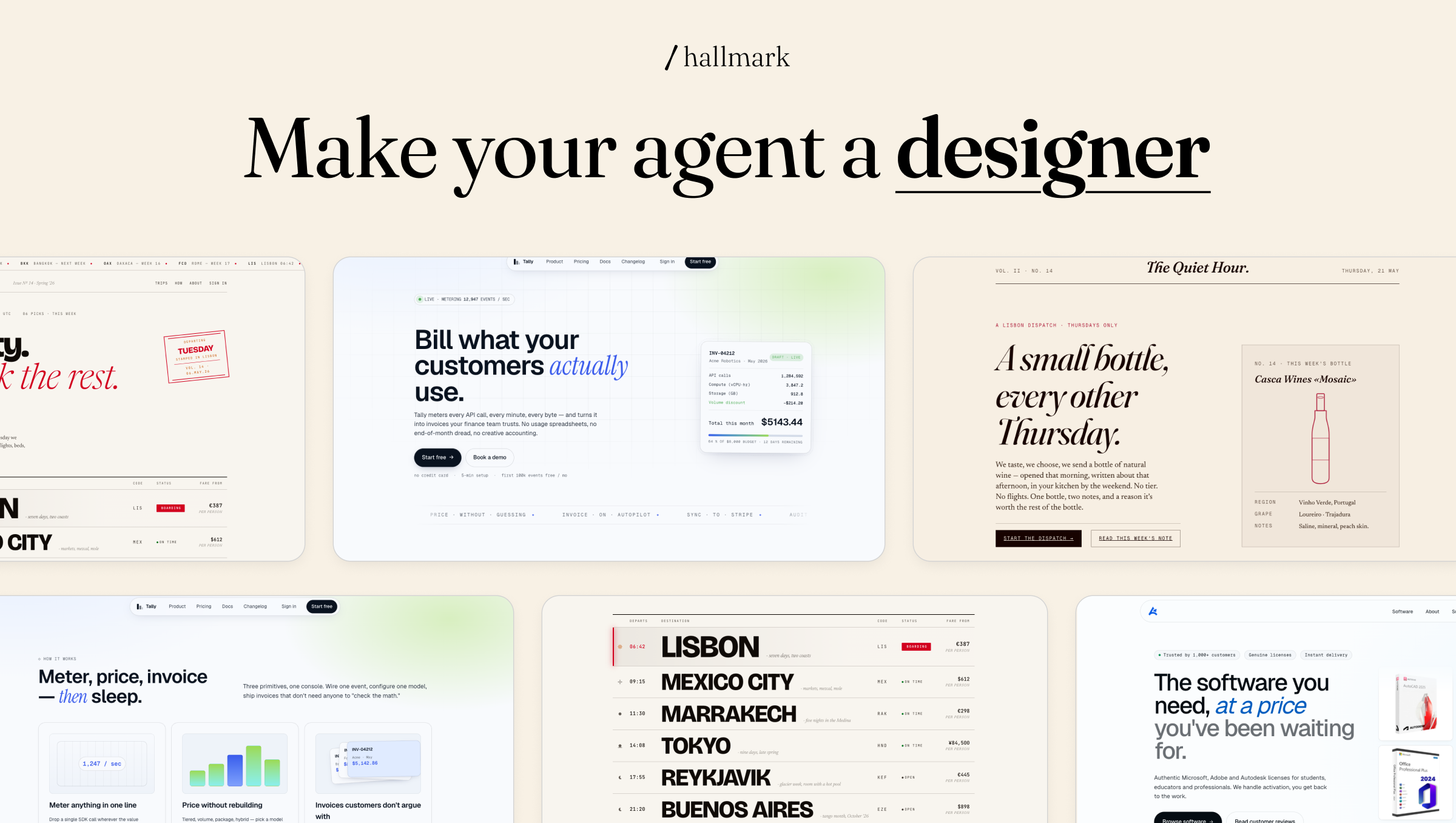
The core claim is specific and testable, not just marketing language: Hallmark picks a macrostructure for the brief, applies one of twenty-one themes, runs it through 57 slop-test gates, and does a pre-emit self-critique before handing the result back. That's a meaningfully different design than a style guide alone — a set of rules an LLM might follow loosely — because it's a checklist the output has to actually pass before it ships. The stated goal, that two pages generated from two different briefs should "feel like different sites, not colour-swaps of the same template," is the bar the whole system is built around clearing.
Four Ways to Use It
Hallmark isn't just a generator — it exposes four distinct verbs that cover the full lifecycle of a design, not just the initial build:
| Verb | What it does |
|---|---|
| (default) | Builds new UI — picks a macrostructure, applies the rule-set, runs the slop test before returning it |
hallmark audit <target> | Scores existing code against the anti-patterns and returns a punch list, without making edits |
hallmark redesign <target> | Keeps the copy, information architecture, and brand, but rebuilds the structure with a different fingerprint |
hallmark study <screenshot | URL> | Extracts the "DNA" — macrostructure, type-pairing, color anchor — from a design you admire, and can emit a portable design.md for other tools |
The study verb is worth calling out specifically: it's explicit about refusing to produce pixel-clones or reproduce paid templates, extracting structural principles rather than copying the actual design — a meaningful ethical line for a tool whose whole premise is learning from existing designs.
What Makes the Variation Real, Not Cosmetic
The example gallery in the README backs up the "different sites, not colour-swaps" claim with output that spans genuinely different structural approaches — a sourdough app, a content-extraction API, a record label, a travel booking product, and a Moroccan fashion brand all come out with visibly different macrostructures and type systems, not the same skeleton in different colors. Each generated page ships as self-contained HTML and CSS, with its macrostructure stamped directly in a CSS comment — a small detail that makes the system's own output auditable after the fact.
When No Catalog Theme Fits: The Custom Branch
Every one of Hallmark's themes is still, by definition, a preset — a named starting point the skill dresses a macrostructure in. The Custom mode exists for the briefs that resist that entirely: when a brief's creative intent doesn't map cleanly onto any catalog theme, Hallmark switches over and designs the page from scratch — a made-to-measure palette, type system, and layout with no template underneath, run through the same 57 slop-test gates as everything else. The README's own examples show what that looks like in practice: a sleeper-train ticket page for a fictional route called The Cascadia Nightjar, and a repair-café broadsheet for The Mend Assembly — neither one resembling a typical landing page structure at all, because neither brief called for one. Custom is deliberately a quiet branch: an ordinary SaaS or product brief never triggers it, and the protocol governing when and how it activates lives in its own reference file (custom-theme.md) rather than being folded into the general rule-set, which keeps the common case predictable while still leaving room for briefs that genuinely need something bespoke.
Where to See It Actually Working
Because the whole pitch rests on structural variation being real rather than asserted, Hallmark ships more than a static gallery to check the claim against. The live demo at usehallmark.com lets you cycle through the theme catalog directly in the browser — pressing T swaps the active theme on the page you're looking at, which is a faster way to feel the difference between macrostructures than scrolling a screenshot grid. For anyone actually adopting the skill, docs/recipes.md and docs/study-examples.md are worth reading before your first real brief: they walk through worked examples rather than just describing the rule-set in the abstract, which matters for a tool whose entire value proposition is in the specifics of how it applies rules to a given brief, not in the rules themselves.
Installing It
Hallmark installs the same way most Claude Code skills do at this point — npx skills add nutlope/hallmark, re-runnable any time to pull updates — or by copying SKILL.md and its references/ folder directly into the right location for whichever tool you're using: ~/.claude/skills/hallmark/ for Claude Code, .cursor/rules/hallmark.mdc for Cursor, or ~/.codex/skills/hallmark/ (personal) or .codex/skills/hallmark/ (project-scoped) for Codex. That cross-tool install path is the same pattern we've seen in other well-built Agent Skills — one source of rules, adapted to whatever format each harness expects.
How It Compares to Diagram Design
Hallmark and Diagram Design are solving the same underlying problem — generic, recognizably-AI output — for two different output types. Diagram Design targets architecture diagrams and flowcharts with a fixed design system and brand-token extraction from a live website. Hallmark targets full page layouts with a broader catalog of macrostructures and themes, plus an explicit anti-pattern gate system rather than a single design-token spec. Both point at the same real gap in current agent tooling: a generic system prompt asking for "clean, modern design" reliably produces the same recognizable output, and closing that gap takes an actual specified rule-set, not a better adjective in the prompt.
What to Weigh Before Relying on It
- 57 gates is a lot of rules to trust blindly. Worth reading
SKILL.mdand thereferences/folder directly at least once to understand what the checklist actually enforces, rather than treating it as an opaque black box that "makes things not look AI-generated." - It's still a young project with no formal releases yet. Active commit history is a good sign, but there's no versioned release history to point to for stability guarantees — pin to a specific commit if consistency matters for a production workflow.
- Structural variety doesn't guarantee quality. A genuinely different macrostructure per brief is real progress over template-swapping, but it's not a substitute for actual design review on anything customer-facing — treat it as raising the floor, not replacing a designer's judgment on the ceiling.
Practical Takeaway
Hallmark is a concrete answer to a complaint nearly everyone using AI for UI generation has had — that the output all looks the same regardless of what was actually asked for — built by a team with real incentive to get it right, since Together AI's own product surfaces benefit from generated UI not looking generic. For teams doing a lot of AI-assisted frontend work, it's worth trying against a real brief and checking whether the structural variation holds up, rather than judging it from the example gallery alone.
Teams building AI-assisted design or frontend workflows — evaluating skills like this one or building house-specific design rule-sets — can get hands-on help from Woyce Technologies.
FAQ
What is Hallmark?
Hallmark is an open-source design skill for Claude Code, Cursor, and Codex, built by Together AI, that generates page layouts using a catalog of macrostructures and themes and runs the output through 57 anti-pattern checks to avoid the generic look typical of AI-generated UI.
How is Hallmark different from just prompting for "modern, clean design"?
A plain prompt still draws from the same statistically common patterns an LLM was trained on. Hallmark uses a specified rule-set — macrostructure selection, a 57-gate slop test, and a pre-emit self-critique — that the output has to pass, rather than relying on the model's own judgment of what looks good.
Can Hallmark audit designs I already have instead of generating new ones?
Yes — the hallmark audit <target> verb scores existing code against its anti-pattern rules and returns a punch list without making any edits.
Does Hallmark copy designs I show it?
No — the hallmark study verb explicitly refuses to produce pixel-clones or reproduce paid templates. It extracts structural principles like macrostructure and type-pairing rather than copying the design itself.
Is Hallmark free to use?
Yes, it's MIT-licensed and open source, installable via npx skills add nutlope/hallmark or by copying the skill files directly into your tool's skills directory.
How is Hallmark different from Diagram Design?
Both are Claude Code skills aimed at reducing generic AI output, but for different targets — Diagram Design focuses on architecture diagrams and flowcharts with brand-token extraction, while Hallmark focuses on full page/UI layouts with a broader theme catalog and an explicit anti-pattern gate system.
What happens if a brief doesn't fit any of Hallmark's catalog themes?
Hallmark switches to its Custom mode and designs the page from scratch — its own palette, type system, and layout, with no template underneath — and still runs the result through the same 57 slop-test gates as a themed page. It's an intentionally quiet fallback: typical briefs never trigger it.
Can I see example output before installing Hallmark?
Yes — the live demo at usehallmark.com shows the theme catalog directly in the browser, and pressing T cycles through themes on the page you're viewing so you can compare macrostructures without installing anything first.
Does Hallmark cost anything to use beyond the underlying model?
No — Hallmark itself is free and MIT-licensed. You still pay whatever your coding agent (Claude Code, Cursor, or Codex) normally charges for the generation itself; Hallmark is a rule-set the agent follows, not a separate paid service.