

Most "AI tutor" products are a chat window bolted onto a quiz generator, with each mode treated as its own disconnected tool and no real memory of what a learner already struggled with last week. DeepTutor, built by the HKUDS research group and backed by a published arXiv paper, takes a different structural approach: chat, quizzes, research, visualization, problem-solving, and mastery practice all run on the same underlying agent loop, sharing the same context and the same memory, rather than being separate features that happen to share a login.
That distinction matters more than it sounds. A tutor that forgets what a student got wrong last week can't adapt, and one that keeps its quiz results in a different silo from its chat history can't connect a wrong answer to the misconception behind it. For anyone building or choosing an AI tutoring agent, those are the gaps that decide whether personalization is real or just a label on the landing page.
This explainer walks through how DeepTutor's single runtime ties its six learning modes together, how its three-layer memory makes personalization inspectable, how it pulls real coding agents and multiple RAG engines into the loop, how it compares with a typical chat-based tutor, and what to check before you install it for real coursework.
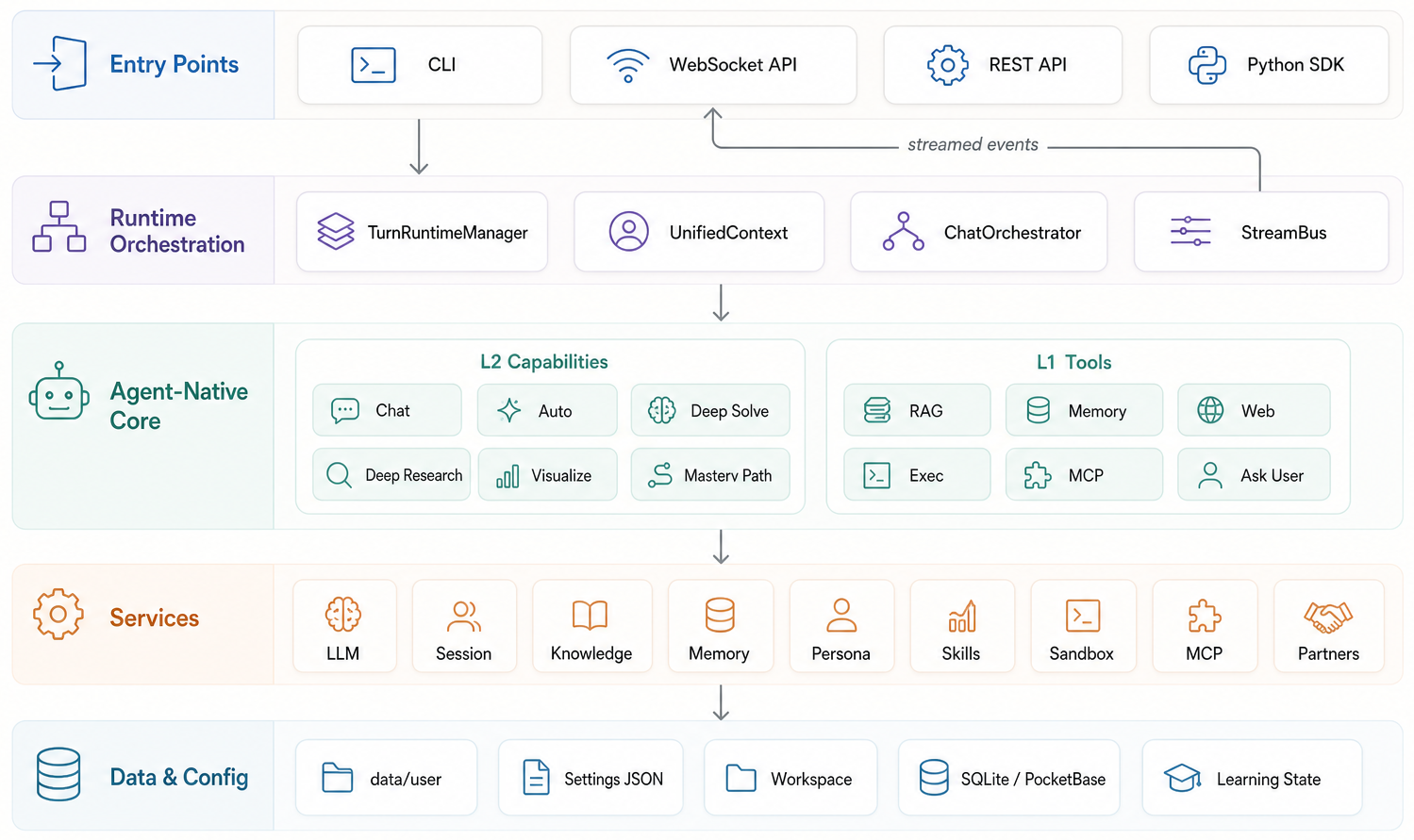
One Runtime, Six Modes
The core design decision is that Chat, Quiz, Research, Visualize, Solve, and Mastery Path aren't six separate tools — they're six objectives running on the same agent runtime, so switching between them changes what the agent is trying to do without losing the context of who the learner is or what they've already covered. Knowledge bases, uploaded books, Co-Writer drafts, notebooks, question banks, and personas all stay available across every mode instead of being scoped to whichever feature created them. That's a meaningfully different architecture than a tutoring app with a quiz tab and a chat tab that don't talk to each other.

Memory You Can Actually Inspect
The feature most worth understanding in depth is DeepTutor's memory system, because it's built to be legible rather than a black box. Memory operates across three layers — L1 raw traces, L2 surface summaries, and L3 synthesized understanding — and a Memory Graph traces every claim the system holds about a learner back to the evidence that produced it. That traceability matters for a genuinely practical reason: a tutoring system that silently misremembers what a student understands is actively harmful to learning, and a memory system you can inspect and correct is the only way to catch that before it compounds over many sessions. "Lifelong personalized tutoring" is the project's own framing, and the memory architecture is what actually makes that claim more than marketing — most chat-based tools lose everything the moment a context window rolls over.

Bringing Your Own Coding Agent Into the Loop
A distinctive feature is direct integration with external coding CLIs — Claude Code, Codex, Gemini, Kimi, opencode, or MiMo can be consulted live from any turn as a subagent, or run persistently as an IM-connected "Partner" sharing the same underlying context. For technical subjects, that means a student working through a coding problem can hand off to an actual coding agent mid-conversation rather than getting a tutor's approximation of what a real coding tool would say — a genuinely useful design for CS and technical education specifically, where the gap between "explains code" and "actually runs and debugs code" matters.

Retrieval Isn't Locked to One Engine
DeepTutor supports versioned knowledge bases across multiple RAG engines — LlamaIndex, PageIndex, GraphRAG, LightRAG — plus a linked Obsidian vault, with pluggable document parsing underneath. That flexibility matters because different retrieval architectures suit different material: a dense technical textbook and a sprawling, loosely connected set of personal notes don't retrieve well through the same engine, and locking a tutoring system to one RAG approach means some subjects end up poorly served no matter how good the model is.
Extensible Through EduHub
Beyond built-in tools, MCP servers, and CLI apps, DeepTutor supports installable community skills through an ecosystem called EduHub, installed with deeptutor skill install behind a security gate — the same "shared, reusable capability" pattern showing up across Agent Skills generally, applied specifically to education. That extensibility is worth taking seriously as a signal about direction: a tutoring platform betting on a skills ecosystem is betting that the interesting long-term value isn't the base chat loop, it's the accumulated library of subject-specific and pedagogy-specific skills built on top of it.
Benefits of DeepTutor
The design choices described above add up to a handful of practical advantages for learners and for the teams that run the platform.
Context That Carries Across Every Mode
Because all six modes run on one runtime, a quiz knows what was discussed in chat, and a mastery path can build on a research session from earlier in the week. Learners don't have to re-explain themselves when switching from asking questions to practising. For teachers, that means a single picture of each learner rather than separate records in disconnected tools, which is the precondition for any personalisation worth the name.
Personalisation You Can Audit
The three-layer memory and the Memory Graph make the tutor's beliefs about a learner visible and traceable to evidence. If the system thinks a student has mastered a topic they still struggle with, someone can see why and correct it. That turns personalisation from an opaque profile into something educators can check, which matters when the system's assumptions shape what a learner is shown next.
Real Tools for Technical Subjects
Handing a coding problem to an actual coding CLI mid-session lets students see code run, fail, and get debugged rather than relying on a description of what should happen. For computer science and other technical courses, that closes the gap between explanation and practice, and it uses tools students may also use in professional settings.
Retrieval Suited to the Material
Support for several RAG engines and an Obsidian vault means a dense textbook, a set of lecture slides, and a sprawling collection of personal notes can each use a retrieval approach that suits them. Subjects aren't poorly served simply because one engine handles their material badly, and teams can experiment with engines without changing platforms.
Control Over Data and Deployment
Self-hosting via PyPI, source, or Docker, with support for local model runtimes, lets institutions keep learner data on their own infrastructure. Multi-user deployments with per-account isolation are a supported configuration, so one instance can serve a class or team. Organisations that need to control where student data goes get options a hosted-only product cannot offer.
DeepTutor Use Cases
These are the settings where DeepTutor's architecture fits most naturally, based on what the project supports today.
Computer Science and Programming Courses
Students learning to code need more than explanations; they need to run code and see what breaks. A course instance with the course materials loaded as a knowledge base lets students ask conceptual questions in chat, then hand a failing exercise to a coding CLI that runs and debugs it within the same session. Quizzes can draw on what came up in those sessions. Students get practical help at the moment they are stuck, and the memory records which concepts caused trouble.
Long-Term Self-Directed Study
Independent learners working through a subject over months lose momentum when every session starts from scratch. With persistent, layered memory, DeepTutor keeps track of what has been covered and where the learner struggled, and the Mastery Path mode can build practice around those gaps. Learners can inspect what the system believes they know and correct it. The result is study that builds on itself rather than repeating the same ground.
Studying From Personal Notes and Books
Many learners keep notes in tools like Obsidian alongside textbooks and papers. Linking an Obsidian vault and uploading books into versioned knowledge bases lets the tutor answer from the learner's own material, using retrieval engines suited to each source. Research and visualisation modes can then work across those sources. Learners get a tutor grounded in what they are actually studying rather than general knowledge.
Small Teams or Classes on a Shared Instance
A training team or a class can run a single self-hosted instance with per-account isolation and admin controls. Each learner keeps a separate memory and file space while the team shares curated knowledge bases. This suits groups with the technical capacity to run the stack and a need to keep learner data in-house.
Reference Architecture for Edtech Builders
Product teams designing their own learning tools can study DeepTutor's memory layers, shared runtime, and skills ecosystem as a working example. Running it locally and inspecting how memory claims link to evidence is a practical way to evaluate design patterns before building them into a different product.
DeepTutor vs a Typical Chat-Based AI Tutor
The easiest way to see what the architecture buys you is to put it next to the pattern most AI tutoring products follow.
| Dimension | Typical chat-based AI tutor | DeepTutor |
|---|---|---|
| Learning modes | Separate chat, quiz, and practice features with their own state | Six modes running as objectives on one shared agent runtime |
| Memory | Whatever fits in the current context window, lost when it rolls over | Three layers (raw traces, summaries, synthesized understanding) with an evidence-linked Memory Graph |
| Inspecting what the tutor "believes" | Not possible; personalization is opaque | Each claim about the learner traces back to the evidence behind it |
| Help with code | The tutor describes what code should do | Can hand off to a real coding CLI as a subagent mid-conversation |
| Retrieval | One built-in RAG pipeline | Versioned knowledge bases across LlamaIndex, PageIndex, GraphRAG, LightRAG, plus Obsidian |
| Extensibility | Fixed feature set | Tools, MCP servers, CLI apps, and EduHub community skills |
| Deployment | Usually hosted SaaS | Self-hosted via PyPI, source, or Docker |
Who it suits, and who it doesn't
DeepTutor fits teams with the technical capacity to run a Python and Node.js stack, configure LLM and embedding providers, and keep up with an active release cadence. It is a strong reference for anyone designing agent memory and personalization into their own learning product. It is a weaker fit for a school or training team that wants a managed, hosted service with a support contract, since there is no first-party hosted version, and for organizations that can't yet commit someone to reviewing release notes before each upgrade.
What's Actually Being Maintained Here
The release history is worth a direct look before evaluating this for anything production-facing — recent versions have shipped real engineering fixes: a streaming parser bug that was silently dropping prose interleaved with tool calls, correct handling of truncated generations (previously misread as the model intentionally finishing), local RAG indexing moved off the shared event loop so it stopped stalling unrelated requests, and per-request output authorization to prevent one user's generated files leaking to another. The most recent release also added a live memory-usage readout in Settings — resident memory across the backend, the Next.js frontend, and any live sandboxes or subagent CLIs, broken out per process, with a warning indicator once usage crosses two-thirds of the configured limit — which is the kind of operational visibility a self-hosted multi-user platform needs and most projects at this stage skip. That's the kind of detailed, unglamorous correctness work that separates an actively maintained platform from one just accumulating features — worth more, honestly, than any individual feature announcement. The project has also crossed 34,000 GitHub stars and cites 20,000 of those arriving within its first 111 days, which at minimum signals a lot of people are watching the release notes closely enough to notice if the pace of fixes slows down.
Getting It Running
DeepTutor ships four installation paths, but the two that matter for most people are installing from PyPI or from source. The PyPI route needs no clone: pip install -U deeptutor, then deeptutor init to walk through backend/frontend ports and LLM provider configuration, then deeptutor start to boot both the Python backend and the bundled Next.js frontend from one terminal. That path requires Python 3.11–3.13 and a Node.js 20+ runtime on PATH, since the packaged Next.js server is spawned by the CLI rather than run separately. The from-source path is aimed at anyone who wants to develop against a checkout — clone the repo, create a virtualenv, pip install -e . for the backend and npm ci --legacy-peer-deps inside web/ for the frontend, then the same deeptutor init and deeptutor start --dev for hot-reloading. A Docker image is published at ghcr.io/hkuds/deeptutor for anyone who'd rather not manage the Python and Node runtimes directly. Either way, settings live under data/user/settings/ in whatever workspace directory you launch from, and skipping deeptutor init entirely still boots the app with default ports — you just configure the LLM and embedding providers afterward in Settings → Models instead of upfront.
Common DeepTutor Evaluation Mistakes
DeepTutor is easy to install and easy to misjudge. These are the mistakes teams most often make when deciding whether it fits.
Judging It by the Feature List Alone
Six modes, multiple RAG engines, coding-agent handoff, and a skills ecosystem make for an impressive list. None of that says how reliably the platform runs under real use. The release history, with its fixes to streaming, truncated generations, indexing concurrency, and per-user file isolation, is the better guide to maturity. Teams that skip it are surprised later by issues the changelog would have flagged.
Treating Self-Hosted as Free
The software is open source, but running it means paying for LLM and embedding usage, a server, and someone's time for configuration, upgrades, and backups. Teams that budget only for the zero licence cost end up with a deployment nobody maintains, which is a particular problem for a multi-user system holding learner data.
Trusting the Memory Without Reviewing It
The point of the Memory Graph is that claims about a learner can be inspected and corrected. If no teacher or learner ever looks, an incorrect belief about what a student understands can persist and shape later sessions. Inspectable memory only helps when someone actually inspects it, especially early in a deployment.
Installing Community Skills Without Scrutiny
EduHub skills install behind a security gate, but that does not make every skill appropriate for every deployment. On a shared instance with student data, a skill that can reach files or external tools deserves the same review as any third-party dependency before it is enabled.
Choosing Small Local Models for Cost Without Testing Quality
Local runtimes keep data on your hardware and cut per-token costs, but smaller models can produce weaker tutoring and memory summaries. Swapping in a local model without comparing output quality on real coursework can quietly degrade the learning experience the platform is meant to improve.
DeepTutor Best Practices
- Read the release notes before every upgrade. The specific classes of bugs being fixed (streaming correctness, memory pressure, indexing concurrency) tell you more about production-readiness than the marketing surface does. Pin a version for each term or cohort and upgrade deliberately between them.
- Start with one course or subject. Load a single knowledge base, run it with a small group, and check retrieval quality and memory accuracy before expanding to more material and more users.
- Match the RAG engine to the material. Multi-engine RAG support means content type shouldn't be a blocker — dense reference material, loosely structured notes, and everything in between have a plausible retrieval path. Test more than one engine on your own content rather than accepting the first default.
- Schedule memory reviews. Have teachers or learners periodically open the Memory Graph and correct claims that don't match reality, particularly in the first weeks of use. Treat repeated corrections in the same area as a sign that retrieval or source material needs attention.
- Use the coding-agent handoff where it fits. For technical and CS education specifically, the live coding-agent integration is the standout feature, genuinely different from a tutor that can only describe what code does. Limit which CLIs are available and what they can access on shared deployments.
- Vet community skills before enabling them. Review what each EduHub skill does and which tools it can reach, and keep a list of approved skills for multi-user instances.
- Watch resource usage. Use the memory-usage readout in Settings to size the server and catch pressure from sandboxes or subagent CLIs before it affects learners. Set the configured limit with headroom for peak use, such as the night before an exam.
- Borrow the memory pattern even if you don't adopt the platform. The memory architecture is worth evaluating on its own merits for any team building personalized learning tools; inspectable, evidence-linked memory is a transferable design pattern.
Practical Takeaway
DeepTutor is a serious attempt at the structural problem most AI tutoring tools skip — treating tutoring, assessment, research, and memory as one connected system instead of stitched-together features — backed by a real research paper and an unusually detailed, honest changelog. For teams building or evaluating AI-driven education products, it's worth studying specifically for its memory architecture and multi-agent integration pattern, whether or not you end up adopting the platform wholesale.
Teams building personalized learning platforms, agent memory systems, or multimodal AI education tools can get hands-on architecture help from Woyce Technologies.
FAQ
What is DeepTutor?
DeepTutor is an open-source, agent-native learning platform from the HKUDS research group. It runs chat, quizzes, research, visualization, problem-solving, and mastery practice on a single shared agent loop, so every mode sees the same learner context and knowledge bases. Its distinguishing feature is a traceable, multi-layer memory system that links what the tutor believes about a learner to the evidence behind it. It is self-hosted and aimed at learners, educators, and teams building personalized learning tools.
Is DeepTutor free to use?
Yes. DeepTutor is open source under the Apache 2.0 license and can be installed with pip install deeptutor, from source, or as a Docker image. The software itself costs nothing, but running it is not free in practice: you supply the LLM and embedding providers, whether paid cloud APIs or local models, plus the server or machine it runs on. Budget for model usage and for someone's time to configure, update, and maintain the deployment.
How is DeepTutor's memory different from a typical chatbot's context window?
A typical chatbot only remembers what fits in its current context window, and that history disappears once the window rolls over. DeepTutor keeps memory across three layers: raw traces, surface summaries, and synthesized understanding. A Memory Graph traces every claim back to the evidence that produced it, so a teacher or learner can see why the system thinks a topic is understood and correct it if it is wrong, rather than trusting an opaque profile that silently drifts.
Can DeepTutor use an actual coding agent for technical subjects?
Yes. It can consult external coding CLIs such as Claude Code, Codex, Gemini, Kimi, opencode, or MiMo live as subagents from any conversation turn, or run one persistently as an IM-connected "Partner" sharing the same context. For computer science and other technical subjects, that means a student can move from an explanation to a tool that actually runs and debugs code, instead of relying on the tutor's description of what the code should do.
What retrieval engines does DeepTutor support?
It supports versioned knowledge bases across several RAG engines, including LlamaIndex, PageIndex, GraphRAG, and LightRAG, plus a linked Obsidian vault, with pluggable document parsing underneath. The practical benefit is that different material can use the retrieval approach that suits it: a dense textbook may retrieve well one way, while loosely connected personal notes may work better through a graph-based engine. You are not locked into a single pipeline that serves some subjects poorly.
Is DeepTutor backed by published research?
Yes. The project links to an arXiv paper describing its approach to lifelong personalized tutoring, and the open-source code is the working implementation of that design. Just as useful for evaluation is the public release history, which documents specific fixes to streaming, truncated generations, indexing concurrency, and per-user file isolation. Reading the paper explains the intent; reading the changelog tells you how mature the implementation is for your use case.
What do I need installed to run DeepTutor?
You need Python 3.11 to 3.13 and a Node.js 20 or newer runtime on your PATH, or Node 22 LTS if you install from source to match CI and Docker. The CLI spawns a bundled Next.js frontend alongside the Python backend, which is why both runtimes are required. If you would rather not manage either, the published Docker image is the simpler route. You also need access to at least one LLM provider and an embedding provider.
Can I install community-built DeepTutor skills?
Yes, through EduHub, the project's community skill ecosystem. Skills are installed with deeptutor skill install, which runs behind a security gate rather than executing arbitrary community code unchecked. Even so, treat community skills like any third-party dependency: review what a skill does and which tools it can reach before enabling it, particularly on a multi-user deployment where students' data and files are involved.
Does DeepTutor support self-hosted or local LLMs, not just cloud providers?
Yes. Alongside major cloud providers, the settings support local runtimes such as LM Studio and llama.cpp, and the release history shows steady expansion of supported model and embedding backends, including Gemini Embedding and NVIDIA NIM. Local models are useful when learner data must stay on your own hardware or when per-token costs matter, though smaller local models may produce weaker tutoring and summaries than large hosted ones.
Is there a hosted version of DeepTutor, or is it self-hosted only?
DeepTutor ships as self-hosted software you run yourself, via pip install deeptutor or Docker. There is no first-party hosted SaaS version. Multi-user deployments with per-account isolation and admin controls are a supported configuration rather than a separate paid tier, so a school or team can run one shared instance. The trade-off is that hosting, upgrades, backups, and security are your responsibility.
Conclusion
The core problem DeepTutor tackles is that most AI tutors forget. They split chat, quizzes, and practice into disconnected features and lose the learner's history whenever a context window fills up, so personalization never compounds.
Its answer is architectural: one agent runtime behind every mode, a three-layer memory whose claims trace back to evidence, retrieval that isn't tied to one RAG engine, and the option to hand technical questions to a real coding agent. Those ideas are worth studying even if you never deploy the platform, because inspectable memory and shared context transfer cleanly to other learning products.
The caveats are practical ones. It is self-hosted, so you own the infrastructure, the model costs, and the upgrades. Community skills deserve the same scrutiny as any third-party code. And the release notes, not the feature list, are the best guide to whether it is ready for real coursework in your setting.
If you are designing a personalized learning product or an agent memory layer of your own, our AI agent development team can help you work through the architecture.